Wednesday, 23 October 2013

Mouth cut out analysis

Animation Analysis


For our animation, we were tasked with having to make an animation with our mouth cut outs. We had to create a drawn out character, and use different mouth cut outs to create the illusion of a flowing scene where the mouth looks as if words are protruding from it.

Stage1: Draw the character or object for the animation
Stage2: Chose and plan the cut out for the mouth, to make the words link with the shapes of the mouth        to create the illusion that the character is speaking.
Stage3: Take individual photos of each of the mouth shapes.
Stage4: Upload the photos up and put them onto final cut pro. Now they are in video form it should look something like the clip above.


Personal Analysis

What went well: How we managed to produce a clip that looks as if the mouth and the voice are paired together. Although the clip is short I believe it is a success.

What could have been improved: If we had been provided with more time, the clip could be longer and have more character too it.



Monday, 21 October 2013

Creature Comfort

Creature comforts was originally a 1989 British humorous animated short film about how animals feel about living in a zoo, featuring the voices of the British public from very corner "spoken" by the animals.


Creature comfort allows a mundane or boring interview to come alive with expresion and bring about a character within a claymation. The original Creature Comforts short film was five minutes long and was conceived and directed by Nick Park and produced by Aardman Animations featuring the voices of British non-actors in the same vein as the "man on the street" Vox Pop interviews.

The voices of each character were performed by residents of both a housing estate and an old people's home. Stop-Motion animation was then used to animate each character, and the answers given in the interviews were put in the context of zoo animals. The Polar Bears were voiced by a family who owned a local shop, while the Mountain Lion was voiced by a Brazilian student who was living in the UK, but missed his home country.

http://www.youtube.com/watch?v=LEwpupSi9Ks

Tim Burton and Aardman and Brothers Quay

Tim Burton was born on Aug. 25, 1958 in Burbank, CA, Burton grew up a lonely and isolated child who quickly became disenchanted with his homogenized suburban surroundings. Burton's withdrawal from his home life - particularly from his father - led him to spend time daydreaming, watching B-movies and pouring through issues of Famous Monsters of Filmland.

During Tims early work he created his first film, Stalk of the celery monster. Due to the success of his first film he was instantly noticed and picked up by Walt Disney Productions' animation studio who offered Tim Burton an apprenticeship at their studio. 

He is famous for his dark, gothic, macabre and quirky take on horror and fantasy style movies such as Beetlejuice, Edward Scissorhands, The Nightmare Before Christmas, Ed Wood, Sleepy Hollow, Corpse Bride, Sweeney Todd: The Demon Barber of Fleet Street, Dark Shadows and Frankenweenie, and for blockbusters such as Pee-wee's Big Adventure, Batman, its first sequel Batman Returns, Planet of the Apes, Charlie and the Chocolate Factory and Alice in Wonderland.


Aardman

Aardman Animations, Ltd., also known as Aardman Studios, or simply as Aardman, is a British animation studio based in Bristol, United Kingdom. The studio is known for films made using stop-motionclay animation techniques, particularly those featuring Plasticine characters Wallace and Gromit. It entered the computer animation market with Flushed Away (2006).


In 1993 Aardman passed another milestone with the completion of Nick Park's Oscar winning The Wrong Trousers, Aardman's first 30 minute film. Acclaimed world-wide and winner of over thirty awards, The Wrong Trousers has become one of the most successful animated films ever made.
In 1995 Aardman produced Nick Park's third Oscar winning film A Close Shave. An immediate success, it confirmed the studio's reputation as well as establishing Wallace and Gromit as household names. In 1996 the studio produced Peter Lord's Oscar nominated 11' short film, Wat's Pig (for Channel Four) as well as a children's series based on Morph, The Morph Files.
In 1998, Aardman won a BAFTA for Stage Fright, an 11minute short film commissioned by Channel Four Television. Steve Box, Nick Park's key animator on both The Wrong Trousers andA Close Shave, directed Stage Fright.
Chicken Run was Aardman's first full-length theatrical feature film to be funded by DreamWorks. Directed by both Peter Lord and Nick Park it was released in June 2000 in the US and UK to excellent reviews and outstanding box office receipts. Chicken Run grossed over $220M at the worldwide box office.

Brothers Quay
Stephen and Timothy Quay are American identical twin brothers better known as the Brothers Quay or Quay Brothers. They are influential stop-motion animators. They are also the recipients of the 1998 Drama Desk Award for Outstanding Set Design for their work on the play The Chairs.
Filmography:
The Cabinet of Jan Svankmajer (1984)
The Unnameable Little Broom (1985)
Street of Crocodiles (1986)
Rehearsals for Extinct Anatomies (1987)
Stille Nacht I-IV
The Comb (1990)
Anamorphosis (1991)
In Absentia (2000)
The Phantom Museum (2003)
BFI Distribution ident (1991)
Introduction by the Quay Brothers (2006)
Nocturna Artificialia (1979)
The Calligraphies (1991)
The Summit (1995)
The Falls (excerpt) (1980)
Archive Interview (2000)

Quay Brothers - The Short Films 1979-2003: RRP 24.99


Friday, 18 October 2013

Other animators


Joseph Plateau

  • Joseph Antoine Ferdinand Plateau (14 October 1801 – 15 September 1883)
  • Belgian physicist 
  • First person to portray the illusion of movement
  • To do this he used counter rotating disks with repeating drawn images in small increments of motion on one and regularly spaced slits in the other. He called this device of 1832 the phenakistoscope.

William Horner 

  • Maths teacher and a master at school
  • His contribution to approximation theory is honored in the designation Horner's methods, in particular respect of a paper in Philosophical Transactions of the Royal Society of London for 1819. The modern invention of the zoetrope.
Emily Reynard

  • Reynaud created the 'praxinoscope in 1877 and the Theatre Optique in December 1888, and on 28 October 1892 he projected the first animated film in public, Pauvre Pierrot, at the Musee Grevin in Paris.
Edward Muybridge Edison

  • He was an English photographer important for his pioneering work in photographic studies of motion and in motion-picture projection.
  • He adopted the name Eadweard Muybridge, believing it to be the original Anglo-Saxon form of his name.
  • Muybridge is known for his pioneering work on animal locomotion in 1877 and 1878, which used multiple cameras to capture motion in stop-motion photographs, and his zoopraxiscope, a device for projecting motion pictures that pre-dated the flexible perforated film strip used in cinematography.

Lumiere Brothers

  • Auguste and Louis Lumière came from Lyon in France, where they worked in their father's photographic factory.
  • In 1894, they saw Edison's kinetoscope in Paris, and decided to design a camera of their own. By February of the next year they had produced a working model of their ciné camera, which they called a cinématographe.
  • The machine was in fact not only a camera but could be used, together with a magic lantern, to project the films which the brothers had taken.
George Pal

  • He was a Hungarian-born American animator and film producer, principally associated with the science fiction genre. 
  • He became an American citizen after emigrating from Europe. 
  • He was nominated for Academy Awards (in the category Best short subjects, Cartoon) no less than seven consecutive years (1942–1948) and received an honorary award in 1944.

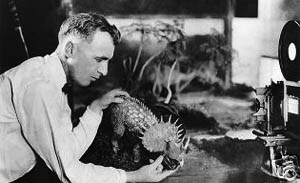
Willis O'Brien
  • He was an American motion picture special effects and stop-motion animation pioneer.
  • Who according to ASIFA-Hollywood "was responsible for some of the best-known images in cinema history," and is best remembered for his work on The Lost World (1925), King Kong (1933) and Mighty Joe Young (1949), for which he won the 1950 Academy Award for Best Visual Effects


Jan Svankmajer

  • He is a Czech filmmaker and artist whose work spans several media. He is a self-labeled surrealist known for his surreal animations and features, which have greatly influenced other artists such as Terry Gilliam, the Brothers Quay, and many others.


Questionnaire- Results


Friday, 4 October 2013

persistence of vision

Persistence of Vision

'Persistence of vision is the phenomenon of the eye by which an afterimage is thought to persist for approximately one twenty-fifth of a second on the retina'. It is also believed to be explanation for motion perception, however it only explains why the black spaces that come between each "real" movie frame are not perceived.

The theory of persistence of vision is the belief that human perception of motion (brain centered) is the result of persistence of vision. The theory was disproved in 1912 by Wertheimer[1] but persists in many citations in many classic and modern film-theory texts. A more plausible theory to explain motion perception (at least on a descriptive level) are two distinct perceptual illusions: phi phenomenon and beta movement.
A visual form of memory known as iconic memory has been described as the cause of this phenomenon. Although psychologists and physiologists have rejected the relevance of this theory to film viewership, film academics and theorists generally have not. Some scientists nowadays consider the entire theory a myth.
In contrasting persistence of vision theory with phi phenomena, a critical part of understanding that emerges with these visual perception phenomena is that the eye is not a camera. In other words vision is not as simple as light registering on a medium, since the brain has to make sense of the visual data the eye provides and construct a coherent picture of reality. 

The discovery of persistence of vision is attributed to the Roman poet Lucretius, although he only mentions it in connection with images seen in a dream. In the modern era, some stroboscopic experiments performed by Peter Mark Rogetin 1824 were also cited as the basis for the theory.

(Wikipedia+wiki100k)

1.^ Wertheimer, 1912. Experimentelle Studien über das Sehen von Bewegung. Zeitschrift für Psychologie 61, pp. 161–265


with reference to Nike Binger Marshall 'Persistence of VIsion'